
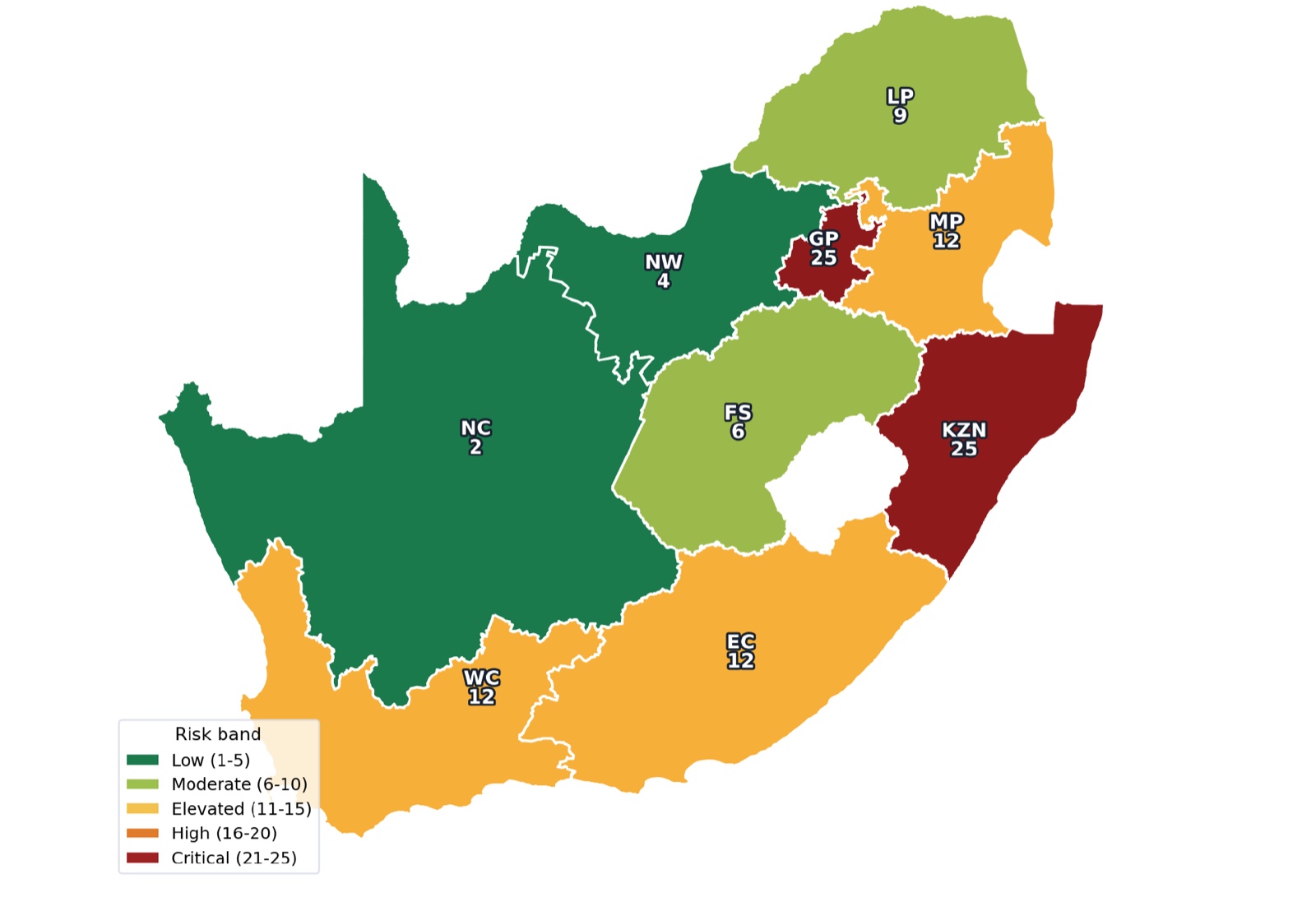
An anti-illegal-immigration coalition led by the movement known as March and March has called a national shutdown for 30 June 2026, with an ultimatum for undocumented foreign nationals to leave South Africa. Gray Guardians assesses that a uniform, nationwide shutdown is unlikely. The credible base case is localised, multi-node disruption concentrated in KwaZulu-Natal and Gauteng, with secondary risk in the Eastern Cape, the Western Cape and Mpumalanga’s border belt. The decisive window is the seven days before the deadline: organisations that pre-position and protect their people will fare markedly better than those that react on the day.
What is the 30 June 2026 “national shutdown”?
March and March, a self-described grassroots movement, has issued an ultimatum: all undocumented foreign nationals must leave South Africa by 30 June 2026, failing which it and aligned groups will “shut down” the country. Its stated demands include a declared state of emergency on illegal immigration and a moratorium on refugee applications. The movement first gained prominence in KwaZulu-Natal and has since expanded into Gauteng, with marches in Tshwane, Johannesburg and the greater Ekurhuleni area; copycat and solidarity actions have been reported more widely, and it now claims activity across all nine provinces.
Government has stated there will be no closure of the country and has committed an extraordinary additional policing budget, with the army on standby and four hotspot provinces named. Counter-mobilisation is visible: civil-society groups, the South African Human Rights Commission and others have condemned the planned action. A peaceful, contained protest remains a real possibility — but the planning judgement must be driven by the plausible downside, because the cost asymmetry is severe and the 2021 onset was rapid. This summary is drawn from open-source reporting to 23 June 2026.
How likely is it — and what is the most probable outcome?
Four scenarios frame the range of credible outcomes, weighted as at 23 June 2026. The economic figures are indicative and benchmarked against the roughly R50 billion impact of July 2021; they are not forecasts.
- Contained protest (~30%): marches proceed largely peacefully; disruption limited to specific routes and a single day. Indicative impact ~R2bn.
- Localised disruption (~40%, base case): road blockages and targeted violence in parts of KZN and Gauteng; freight on the N3 and N2 interrupted for one to several days. Indicative impact ~R12bn.
- Multi-node flare-up (~22%): disruption takes hold across several metros and corridors, stretching the security response. Indicative impact ~R35bn.
- Systemic unrest (~8%): a 2021-scale event that outpaces the state — the worst-case planning bound. Indicative impact ~R60bn.
Plan around the base case, but harden against the tail.
Which provinces and routes are most at risk?
Exposure is highly uneven. Two provinces carry critical risk and account for the overwhelming majority of the credible downside; three form a clear elevated second tier; the remainder are moderate to low, with risk concentrated on cross-border trade corridors rather than broad urban unrest.
- KwaZulu-Natal — Critical. The movement’s home base and the 2021 epicentre; Durban port and the N3 origin; plan for inter-communal (“Phoenix-type”) violence, not only protest.
- Gauteng — Critical. The economic core; sustained mass action in Ekurhuleni (Benoni, Actonville, Wattville, Tembisa); dense formal and informal retail.
- Eastern Cape, Western Cape & Mpumalanga — Elevated. East London unrest and export exposure; diffuse, already-fatal violence in the Southern Cape and Overberg; the Lebombo / Komatipoort border belt.
- Limpopo & Free State — Moderate. Corridor-specific risk at the Beitbridge border and the N1 chokepoint at Bloemfontein.
- The N3 and N2 — treat as red routes. Freight can be interrupted within hours and is difficult to reroute at scale.
The single most important spatial feature is the eThekwini–Johannesburg–Ekurhuleni triangle and the N3 spine between them.
Why July 2021 is the benchmark
The July 2021 unrest is the controlling precedent. Over nine days across KwaZulu-Natal and Gauteng it cost about 354 lives and stripped roughly R50 billion from the economy. The mechanics are the planning lesson: the N3 and N2 were blocked and trucks burned within hours, a major refinery declared force majeure, port operations in Durban were attacked, and malls, distribution centres and the cold chain were hit hardest. The onset outpaced the security response — which is precisely why preparation must be finished before the window, not improvised inside it.
What should organisations do now?
Recommendations are organised by phase, and personnel safety takes precedence over asset protection throughout. The decisive variable is preparation completed before 30 June.
- Protect people first. Identify staff, drivers and contractors who may be targeted as foreign or perceived as foreign, and offer remote work or stand-down around the deadline.
- Harden and pre-position now. Complete site hardening and secure distribution centres; pre-position critical stock, fuel and cash; do not rely on resupply during the event.
- Treat the N3 and N2 as red routes. Avoid non-essential movement over 30 June and the days either side; where freight is unavoidable, use daylight convoys with live tracking and pre-agreed abort triggers.
- Confirm SASRIA cover. Verify that special-risk insurance for riot and unrest damage is current, and capture a dated, photographed asset baseline to support any later claim.
- Stand up a common operating picture. Monitor flashpoint nodes in real time, with one point of coordination and pre-agreed decision triggers for shutdown, shelter-in-place or withdrawal.
- Plan for cascade, not just local impact. Even sites far from the flashpoints should expect supply, fuel and cash-flow effects if the corridors are interrupted.
People first, assets second — and preparation finished before 30 June, not during it.
View the live response dashboard →
This assessment is provided by Gray Guardians for protective and continuity planning. It is based on open-source information available to 23 June 2026 and on professional judgement; the situation may change rapidly. It does not constitute legal, insurance or financial advice. The full report, including methodology, sectoral analysis and province briefs, is available to download below.